The Enduring Charm of Classic CRT Televisions and Their Place in Modern Digital Design
Few objects carry the same wave of instant nostalgia as a classic CRT television. That curved glass screen, the gentle hum when it powered on, the soft glow warming a dim living room corner—these memories are etched into generations of viewers. But beyond sentimentality, cathode-ray tube technology represents a fascinating chapter in engineering history, one that continues to inspire artists, designers, and illustrators today. Understanding how these devices worked, why they mattered, and how their visual language persists in contemporary media helps us appreciate both the past and the creative tools now available to capture its essence.
What Exactly Is a CRT Television?
At its core, a CRT, or cathode-ray tube, is a vacuum tube that produces images when an electron beam strikes a phosphorescent surface. The term might sound clinical, but the result was anything but. These televisions dominated living rooms from the mid-20th century well into the early 2000s, serving as the primary window to news, entertainment, and cultural moments shared by millions simultaneously. A CRT television operates by firing electrons from a heated cathode toward a phosphor-coated screen. Magnetic coils steer the beam in a precise scanning pattern—left to right, top to bottom—painting the picture faster than the human eye can perceive. This rapid scanning creates the illusion of a complete, moving image.
What makes this technology particularly interesting in retrospect is its analog nature. Unlike modern flat-panel displays with their fixed pixel grids, CRT televisions produce images through continuous electronic signals. This characteristic gave them distinct visual properties: deep blacks, natural motion rendering, and a certain warmth that digital displays sometimes struggle to replicate. The slight curvature of the screen, the subtle scanlines visible up close, and the occasional static crackle all contributed to an experience that was as tactile as it was visual.
The Anatomy of a Classic Television Set
To truly understand CRT televisions, it helps to visualize their construction. A typical set consisted of several key components working in harmony:
- The Cathode: A heated filament that emitted electrons, serving as the source of the image-creating beam.
- The Electron Gun Assembly: A series of electrodes that focused and accelerated electrons into a tight stream aimed at the screen.
- Deflection Yoke: Copper coils wrapped around the tube neck that generated magnetic fields, steering the electron beam horizontally and vertically.
- Phosphor Screen: The inner surface of the glass coated with red, green, and blue phosphor dots or stripes that lit up when struck by electrons.
- Shadow Mask or Aperture Grille: A thin metal sheet with precise holes or slots ensuring each electron beam hit only its intended color phosphor.
- Glass Envelope: The heavy, lead-infused glass bulb that maintained the vacuum necessary for electron flow and protected users from radiation.
Each of these elements played a critical role, and their interplay determined picture quality, color accuracy, and the overall viewing experience. The weight of these components explains why CRT televisions were so notoriously heavy—a 32-inch set could easily tip the scales at over 150 pounds.
Why CRT Televisions Still Matter in a Flat-Screen World
It might be tempting to dismiss CRT televisions as obsolete relics. After all, we live in an era of wafer-thin OLED panels, 8K resolution, and screens that roll up like posters. Yet dismissing them entirely misses something important. CRT technology shaped how we consume media, influenced broadcast standards, and established design languages that persist in unexpected places. Retro gaming enthusiasts, for example, actively seek out CRT displays because classic game consoles were designed with the quirks of cathode-ray tubes in mind. Pixel art from the 8-bit and 16-bit eras looks fundamentally different on original hardware connected to a CRT—smoother, more blended, with intentional color bleeding that artists leveraged as part of their visual toolkit.
Professional video editors and broadcast engineers also maintain an appreciation for CRT technology. Many reference monitors used in post-production throughout the 1990s and early 2000s were high-end CRT units prized for their color accuracy and contrast ratios. Some purists argue that certain aspects of motion handling and black-level performance in top-tier CRT monitors have yet to be fully surpassed by consumer-grade flat panels, though this remains a nuanced and debated topic.
Common Misunderstandings About CRT Displays
Several misconceptions have settled around CRT televisions over the years. One prevalent myth is that they were universally dangerous due to radiation emission. In reality, regulatory standards enforced strict limits on radiation leakage, and properly functioning sets posed negligible risk to viewers. The lead content in the glass was indeed a genuine environmental concern for disposal, but during normal operation, the glass envelope contained any harmful emissions effectively.
Another common assumption is that CRT picture quality was inherently poor. While lower-end consumer models certainly had limitations, premium CRT displays achieved remarkable fidelity within their technical constraints. The perception of poor quality largely stems from degraded memories of aging hardware—worn-out tubes, misaligned convergence, and weak signal sources—rather than the technology's actual potential when properly calibrated.
The Visual Legacy of CRT Televisions in Graphic Design and Illustration
The distinctive silhouette and screen characteristics of classic CRT televisions have become powerful visual shorthand in modern graphic design. When a designer wants to evoke a sense of nostalgia, retro-futurism, or the early digital age, few motifs work as immediately as the rounded rectangle of a vintage television set. This iconography appears in everything from app logos and website headers to editorial illustrations and product packaging.
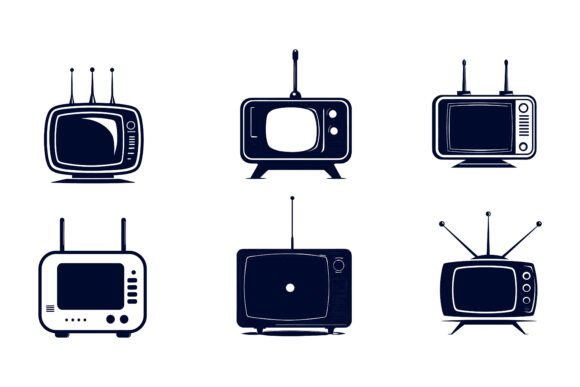
This brings us to an exciting development for designers and creatives who want to incorporate these classic elements into their work. Hello Welcome to our Special AI EPS Collections—a meticulously crafted illustration set that captures the essence of classic CRT televisions in versatile, editable vector formats. Understanding what makes this collection stand out can help you decide whether it fits your next creative project.
What Makes This AI EPS Illustration Set Special for You
Whether you are designing a retro-themed website, building an app interface that pays homage to vintage technology, creating infographics about media history, or developing print materials with a nostalgic twist, having high-quality source illustrations saves hours of painstaking work. This collection stands apart for several practical reasons that directly benefit your workflow and final output quality.
The illustration file includes multiple formats to ensure compatibility across different software ecosystems. You receive AI EPS and JPG files, giving you the flexibility to work in vector applications like Adobe Illustrator for infinite scalability or to use the raster versions for quick placement in layouts and presentations. The collection was designed for both Mac and Windows users, removing any platform-related friction from your creative process.
One of the most frustrating experiences for a designer is opening a purchased asset only to find a chaotic mess of unnamed layers and grouped objects that resist editing. This collection addresses that pain point with a neatly organized file and layer structure. Every element is logically named and grouped, allowing you to navigate the artwork intuitively. This organizational discipline means you spend less time deciphering someone else's file architecture and more time being creative.
Quality reveals itself in the details. The illustrations demonstrate perfection in details and consistency, ensuring that every curve, highlight, and shadow behaves as expected. When you place these assets alongside your own design elements, they integrate seamlessly rather than standing out as mismatched imports. Consistent styling across the entire collection means you can use multiple illustrations together without visual dissonance.
Versatility extends beyond file formats. These illustrations are suitable for print, web, symbols, apps, and infographics. The scalable vector nature means a single illustration can appear crisply on a business card or stretch across a billboard without degradation. The aesthetic translates across mediums, maintaining its impact whether rendered in CMYK for offset printing or in RGB for digital screens.
Perhaps the most empowering feature for designers is the editability. You can edit it, change colors, and modify the icon easily according to your needs. Brand color palettes, thematic variations, or client-specific requirements become trivial to accommodate. Need the television set in a specific shade of teal to match a brand guide? Simply select and recolor. Want to adjust the proportions or combine elements from different illustrations? The structured layers make such modifications straightforward.
Practical Applications Across Creative Fields
The use cases for classic CRT television illustrations span an impressive range of disciplines. Consider how different professionals might leverage this collection:
- Web Designers building landing pages for retro gaming platforms, streaming services featuring classic content, or technology museums can use these illustrations as hero images or section dividers.
- App Developers creating media player interfaces, nostalgia-focused social platforms, or educational tools about broadcasting history can integrate the icons as UI elements.
- Print Designers working on event posters for retro film festivals, album artwork for synthwave musicians, or editorial layouts for technology retrospectives find these assets immediately useful.
- Infographic Specialists illustrating the evolution of display technology, media consumption habits, or the timeline of home entertainment benefit from recognizable, accurate visual representations.
- Content Creators producing YouTube thumbnails, social media graphics, or podcast cover art with a vintage tech theme can quickly incorporate the illustrations into their templates.
Why Vector Format Matters for CRT-Inspired Artwork
The choice of AI and EPS as primary delivery formats is not arbitrary. CRT televisions have distinct geometric qualities—curved glass, straight cabinet lines, circular control knobs—that translate beautifully into vector paths. Bezier curves can replicate the smooth arc of a picture tube with mathematical precision. Gradients can simulate the subtle glow of a powered-on screen. The vector format preserves these qualities at any size, something bitmap images cannot guarantee. For symbol and icon work especially, this scalability is indispensable. An icon destined for a mobile navigation bar must read clearly at 24 by 24 pixels, while the same illustration used as a splash screen graphic might need to fill 1920 pixels or more. Vector art bridges this range effortlessly.
Bridging Nostalgia and Modern Workflows
There is something poetic about using cutting-edge design software and artificial intelligence tools to recreate the visual language of decades-old technology. It speaks to a broader cultural pattern where vintage aesthetics are continuously rediscovered and reinterpreted through contemporary lenses. CRT televisions, once the pinnacle of home entertainment, now serve as cultural artifacts whose form carries meaning beyond their original function.
For designers working under tight deadlines, the availability of ready-made, professional-grade illustration sets transforms what could be a multi-hour custom illustration task into a matter of minutes. The time saved on asset creation can instead be invested in refining layouts, perfecting typography, or exploring creative variations. This efficiency does not come at the cost of uniqueness because the extensive editability allows each designer to put their distinct stamp on the final product.
So what are you waiting for? Buy now and start using this awesome illustration. The combination of nostalgic appeal, professional construction, and practical flexibility makes this AI EPS collection a valuable addition to any designer's toolkit. Whether you need a single icon for a mobile app or a cohesive illustration family for a large-scale branding project, these assets provide a foundation you can build upon with confidence.
Looking Forward While Glancing Back
The story of CRT televisions does not end with their technological obsolescence. Through design, illustration, and creative reinterpretation, their visual essence persists and evolves. They remind us that objects can carry meaning far beyond their functional lifespan. The warm glow of a vintage television set, whether rendered in phosphor on glass or in vectors on a Retina display, continues to capture our collective imagination. Understanding the technology behind the icon makes the illustration work richer and more informed. Knowing that designers have access to high-quality, editable resources means that more creative projects can authentically reference this important chapter in visual culture without starting from scratch. The past illuminates the present, sometimes quite literally, and always through beautifully designed vectors.