Kid Throwing Garbage in the Trash Bin: A Visual Tool for Everyday Learning and Creative Projects
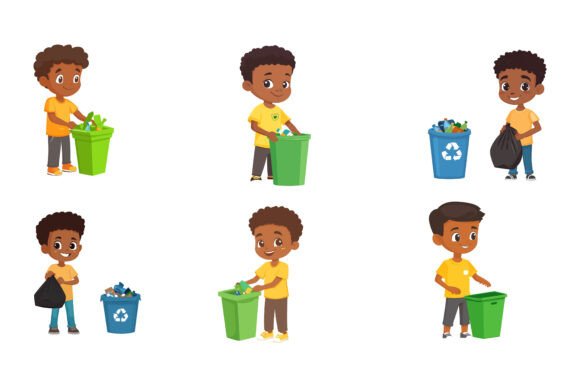
Some images do more than fill a page. They tell a story, spark a conversation, or quietly reinforce a habit we want children to carry for life. The illustration of a Kid Throwing Garbage in the Trash Bin belongs to that category. It is simple in concept yet remarkably versatile in application. Whether you are designing a classroom poster, building an app interface, or putting together a community awareness campaign, this single visual can anchor an entire message about responsibility, cleanliness, and care for shared spaces.
What makes a well-crafted vector illustration stand out is not just the subject matter but the thoughtfulness behind its construction. When you open a properly organized AI EPS file, you are not wrestling with a flattened image. You are stepping into a workspace where every element has been placed with intention, where layers are named logically, and where the smallest details—the curve of a child's hand, the slight tilt of a trash bin, the scattered light on a crumpled wrapper—have been refined until they feel natural and believable.
Why This Illustration Matters in a Visual-First World
We process visuals faster than text. A child seeing another child perform a positive action is far more likely to imitate that behavior than if they simply heard a verbal instruction. This is the quiet psychology behind the Kid Throwing Garbage in the Trash Bin illustration. It models the desired behavior without a single spoken word. For educators, parents, and content creators, that makes the image a valuable shortcut to teaching environmental awareness and personal responsibility.
Beyond the educational angle, the illustration carries an emotional quality that stock photography often misses. There is something earnest and unposed about a well-drawn child figure engaging in a mundane yet meaningful act. It feels genuine rather than staged, approachable rather than sterile. That tonal difference matters when you are trying to connect with an audience on a human level.
How the AI EPS Format Unlocks Creative Flexibility
If you have ever worked with raster images that pixelate the moment you scale them up, you understand the quiet frustration of fixed resolutions. The AI EPS and JPG combination solves that problem elegantly. The EPS file preserves the vector data, meaning you can enlarge the illustration to billboard size or shrink it down to a mobile icon without losing a shred of clarity. The included JPG gives you a ready-to-use raster version when you need a quick placement without opening illustration software.
The file has been designed for Mac and Windows users, which is a practical consideration that deserves attention. Cross-platform compatibility means you will not encounter missing fonts, broken paths, or operating-system-specific quirks when moving between devices or collaborating with team members on different setups. The illustration simply works, regardless of where you open it.
Layer Structure and Organization
Anyone who has spent hours untangling a poorly organized vector file knows the value of a neatly organized file and layer structure. This illustration set prioritizes clarity from the ground up. Each component—the child figure, the trash bin, the garbage item, background elements, and subtle shadow details—resides on its own named layer. This approach transforms editing from a chore into a straightforward process. You can isolate the child character and recolor their clothing without touching the bin. You can adjust the background independently. You can swap out the type of garbage being thrown away to match a specific waste-sorting campaign. The organized structure respects your time and creative judgment.
Detail Consistency That Professionals Notice
There is a difference between an illustration that looks fine at thumbnail size and one that holds up under close scrutiny. Perfection in details and consistency is not marketing language here—it is a practical standard. The line weights remain uniform where they should be uniform. The lighting direction stays coherent across all elements. The proportions of the child figure feel anatomically plausible without being rigidly realistic. These details accumulate into a professional finish that suits client presentations, branded materials, and published work where quality expectations run high.
Where This Illustration Finds Its Place
The question is not only what the illustration depicts, but where it can live and function effectively. The versatility of a vector-based illustration opens doors across multiple mediums and industries.
- Print materials — Classroom posters, educational worksheets, children's books, recycling guides, municipal flyers, and environmental campaign banners all benefit from illustrations that communicate instantly. The crisp output of an EPS file ensures clean reproduction on paper, even at large formats.
- Web and digital platforms — Websites focused on parenting, sustainability, early childhood education, or community initiatives can use the illustration as a hero image, blog accompaniment, or interactive element. Because the file is suitable for print and web, you can repurpose the same visual asset across online and offline channels without quality compromises.
- App interfaces and symbols — Mobile applications that gamify waste sorting, teach children daily routines, or manage household chores can integrate the illustration as an icon, button graphic, or onboarding screen element. The clean silhouette and clear subject matter make it readable even at small sizes.
- Infographics and data visualization — When presenting statistics about recycling rates, community cleanliness initiatives, or child behavior studies, the illustration can serve as a supporting visual that humanizes the numbers. A child actively participating in waste disposal personalizes data that might otherwise feel abstract.
Who Benefits From This Illustration Set
The audience for a Kid Throwing Garbage in the Trash Bin illustration is broader than it initially appears. Consider the following groups and how they might put the visual to work.
Educators and School Administrators
Teachers building lesson plans around environmental stewardship can incorporate the illustration into slides, handouts, and classroom displays. The editable nature of the file means they can adapt colors to match school branding or adjust elements to reflect specific recycling guidelines relevant to their municipality. A kindergarten teacher might enlarge the child character for a bulletin board, while a middle school science teacher might integrate it into a diagram about waste management systems.
Parents and Home Organizers
At home, visual cues are powerful tools for establishing routines. A printed version of the illustration placed near a household bin serves as a gentle, non-verbal reminder for young children who are still forming habits around tidiness. Because you can edit it, change colors, and modify the icon easily according to your needs, parents can personalize the character to resemble their own child, strengthening identification and engagement.
Graphic Designers and Creative Professionals
Designers working on client projects value assets that do not lock them into rigid usage constraints. The ability to recolor, reshape, and recontextualize the illustration means it can adapt to brand guidelines, campaign themes, and evolving creative directions. A designer creating a series of sustainability icons can extract the trash bin element, adjust the stroke style, and build a cohesive icon family without starting from scratch.
Nonprofit Organizations and Community Groups
Organizations running cleanliness drives, recycling awareness programs, or environmental education workshops need visuals that resonate across age groups and cultural contexts. The universal act of a child disposing of garbage transcends language barriers. Community groups can use the illustration on social media graphics, event banners, and informational pamphlets to attract attention and convey their mission clearly.
Practical Considerations When Using Vector Illustrations
While the benefits are substantial, there are practical points worth considering before integrating any illustration into a project. The AI EPS format requires compatible software such as Adobe Illustrator, CorelDRAW, Affinity Designer, or other vector editing applications. Users unfamiliar with these tools may face a learning curve when attempting advanced modifications. However, for basic color changes or resizing, the included JPG format or simpler vector editors can suffice.
Another consideration involves context sensitivity. The illustration depicts a specific action within a specific cultural framing of waste disposal. If your project addresses communities with different waste management practices—such as composting-dominated systems or multi-stream recycling—you may need to supplement the illustration with additional visuals that represent those specific processes. The editable nature of the file makes such adaptations feasible, but they do require time and design capability.
File size and rendering performance also deserve brief attention. Complex vector files with many layers and detailed paths can become demanding on older hardware when opened in illustration software. The neatly organized file and layer structure helps mitigate this by allowing you to hide unnecessary layers while working, but it is worth keeping in mind if your setup has limited processing power.
Real-World Scenarios That Illustrate Value
Imagine a municipal waste management department preparing a public education campaign. They need visuals for printed brochures, a responsive website, and large-format bus stop advertisements. A single vector illustration of a Kid Throwing Garbage in the Trash Bin can serve all three channels without quality loss or format conversion headaches. The department's in-house designer can adjust the colors to match the city's branding, add a localized recycling logo to the bin, and export versions optimized for each medium—all from the same source file.
Consider an independent app developer building a children's routine tracker. The app uses illustrated badges to reward completed tasks. The trash bin illustration becomes the badge for "cleaned up my space." Because the vector file is editable, the developer can simplify the illustration to a flat icon style, recolor it to match the app's pastel palette, and export it at multiple resolutions for various screen densities. The perfection in details and consistency ensures the badge looks polished alongside other illustrated elements.
Think of a parent who runs a small online store selling printable chore charts and routine cards. They purchase the illustration, recolor the child's outfit to offer multiple skin tone and clothing variations, and create a product line that feels inclusive and customizable. The editable file format turns a single purchase into a versatile asset that supports an entire product category.
Evaluating Suitability for Your Specific Project
Before adding this illustration to your toolkit, ask a few guiding questions. Does your project require a human element that conveys warmth and approachability, or would abstract icons serve better? Will the visual appear across multiple formats that demand scalable, resolution-independent files? Do you need the freedom to recolor, restructure, or repurpose elements over time? If the answers lean toward yes, the Kid Throwing Garbage in the Trash Bin illustration aligns well with your needs.
Also consider the stylistic fit. The illustration uses a friendly, accessible aesthetic that suits educational, family-oriented, and community-focused contexts. If your project demands a corporate, minimalist, or highly technical visual language, you may need to assess whether the warmth of the illustration complements or conflicts with your overall design direction.
The Role of Editable Assets in Modern Creative Workflows
The broader trend in creative work favors assets that do not lock users into a single outcome. Templates, editable vectors, and modular design elements reflect a shift toward efficiency and personalization. The AI EPS illustration set fits squarely into this philosophy. It provides a starting point rather than a finished endpoint, respecting the user's ability to shape the final result according to their unique requirements.
This flexibility translates into long-term value. A static image might serve one campaign. An editable illustration can serve dozens, evolving alongside changing needs, branding updates, and new project directions. The initial investment multiplies as the asset finds new applications over time.
The Kid Throwing Garbage in the Trash Bin illustration captures a moment that is both ordinary and significant. It freezes an act of care that, repeated thousands of times across communities, shapes the environments we share. For the creators, educators, and professionals who use it, the illustration becomes a practical tool—easy to work with, adaptable, and consistently polished. The organized layers, cross-platform compatibility, and editable structure remove friction from the creative process, leaving more room for the message itself to shine through.