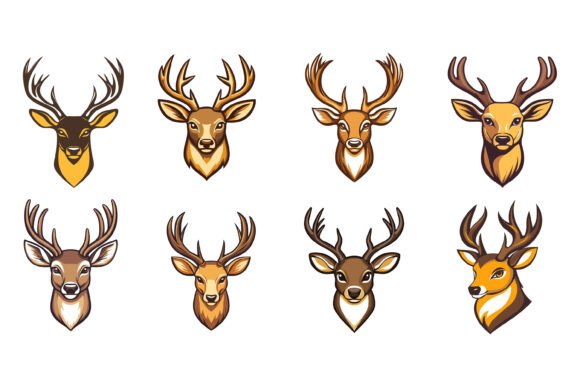
The Art and Utility of a Versatile Set of Deer Heads in Vector Illustration
Why Deer Head Motifs Continue to Captivate Designers Across Disciplines
Few symbols in visual communication carry the same quiet authority as a well-rendered deer head. The silhouette of antlers branching upward, the poised alertness of the gaze, and the organic contours of the neck and shoulders combine into an image that resonates across cultures and contexts. A carefully crafted set of deer heads offers designers more than mere decoration. It provides a visual shorthand for concepts like wilderness, grace, renewal, and resilience. Whether placed on a craft beer label, integrated into a lodge-style logo, or used as a central element in an infographic about wildlife conservation, deer head illustrations adapt with surprising ease to different tones and messages.
What makes this particular motif so enduring is its dual nature. The deer head can read as majestic and serene in one composition, then rugged and rustic in another. This flexibility explains why illustrators and graphic designers return to the subject repeatedly, and why having access to a refined collection changes the speed and quality of creative workflows. When those illustrations arrive as AI EPS files with organized layer structures, the practical advantages multiply quickly.
Understanding File Formats and Their Roles
Anyone who has worked extensively with vector graphics knows that file format dictates freedom. The AI format preserves native Adobe Illustrator editing capabilities, which means every anchor point, bezier curve, and path remains accessible. EPS serves as the universal exchange currency, opening reliably across CorelDRAW, Affinity Designer, Inkscape, and older software versions. Including JPG previews alongside these working files adds a pragmatic layer. Scanning a folder of preview images takes seconds compared to opening each vector file individually. This combination of AI, EPS, and JPG in a single package reflects an understanding of how professionals actually navigate their asset libraries during fast-moving projects.
Cross-Platform Compatibility as a Foundation
Design environments today are split between Mac and Windows ecosystems, often within the same team. A collection engineered for both platforms eliminates the friction of font substitutions, rendering discrepancies, or path interpretation errors that can plague single-platform files. When a set of deer heads is structured for cross-platform use, a designer in a Windows-based studio can hand off files to a Mac-using client without conversion headaches. This might sound like a minor detail, but anyone who has debugged a corrupted EPS at 11 PM before a deadline understands its real value.
Layer Organization and Why It Accelerates Production
Opening a vector file to find a single flattened layer is one of the quiet frustrations of stock illustration work. Thoughtfully organized layers transform the editing experience. A deer head illustration might separate the antlers onto their own layer, the facial details onto another, and the neck and shading onto additional tiers. This structure allows a designer to isolate and recolor the antlers without touching the face, or to apply a gradient to the neck while preserving the crisp linework above it. The time saved accumulates across dozens of iterations, client revisions, and variant exports.
Attention to Detail and Stylistic Consistency
The difference between an amateur deer head illustration and a professional one often comes down to consistency. Do the antler tines taper naturally? Does the fur texture follow anatomical logic? Are the eye proportions balanced across all angles in the set? When an illustrator commits to perfection in details, every piece in the collection maintains the same standard. This consistency matters especially when multiple deer heads appear together in a single layout, such as a pattern design, a brand identity system, or an educational chart comparing species. Variations in line weight, stylization approach, or level of realism become immediately apparent and undermine the cohesion of the final piece.
Brand Identity and Logo Design
The hospitality industry has long embraced deer imagery for its associations with nature, authenticity, and heritage. Breweries, distilleries, coffee roasters, and farm-to-table restaurants frequently incorporate deer head marks into their visual identities. A vector-based set of deer heads gives brand designers the ability to test multiple compositions rapidly. They can compare a minimalist line-art treatment against a more detailed, engraving-style approach without commissioning custom illustration for each option. Beyond hospitality, outdoor equipment brands, hunting conservation groups, and even financial institutions seeking to evoke stability and foresight have adopted deer symbolism. The ability to edit colors and modify icon details directly within AI or EPS files means designers can align the illustration perfectly with existing brand palettes and style guides.
Print Media and Merchandise
Screen printing, embroidery, and letterpress each impose specific technical requirements on artwork. Vector illustrations handle these demands natively because they scale without degradation and separate cleanly into spot colors. A deer head destined for a t-shirt design needs crisp edges and manageable color separations. The same illustration enlarged for a wall mural or a trade show banner must retain its clarity at several feet wide. The JPG previews included in a well-organized collection help production managers and printers quickly assess which file suits their output method without opening every vector file.
Digital Interfaces and Infographics
User interface designers increasingly incorporate illustrated elements to soften digital experiences and inject personality into apps, onboarding screens, and icon systems. Deer head icons can represent categories like nature, wildlife, hunting, or seasonal content in a way that feels more refined than generic symbols. Infographics benefit similarly. A data visualization about forest ecosystems, deer population studies, or biodiversity indicators gains visual impact when accurate, attractive illustrations accompany the numbers. The organized layer structure of a quality vector set allows UI designers to extract specific elements, adjust line weights for different screen densities, and recolor assets for light and dark mode variants.
Color Modification and Theming
One of the most immediate practical benefits of AI and EPS files is unrestricted color editing. A deer head illustration rendered in earthy browns and forest greens can become monochromatic charcoal for a minimalist brand, neon-bright for a festival poster, or metallic gold for a premium product label. Designers can sample colors directly from a client's brand guide and apply them to the illustration in seconds. This adaptability extends beyond flat color swaps. Gradient meshes, opacity variations, and blending modes all remain editable within the native AI format, enabling sophisticated effects that rasterized assets simply cannot support.
Icon Simplification and Detail Adjustment
Not every project calls for a highly detailed deer head. A mobile app icon may need a simplified silhouette that reads clearly at 24 by 24 pixels. A favicon requires even greater reduction. Starting with a detailed vector illustration and removing complexity is far easier than adding detail to an oversimplified source. The organized layers in a professional set make this process intuitive. A designer can hide the texture and shading layers, keep the core outline visible, and export a clean, minimal version in minutes. The same source file continues to serve the project as needs evolve from simple icons to elaborate hero graphics.
Mixing and Matching Across a Set
A collection that includes multiple deer head variations opens creative possibilities beyond what a single illustration can provide. Designers can create pattern repeats that alternate between different angles, species, or stylistic treatments. They can build comparative displays for educational materials. They can select different heads for different branches of a brand architecture while maintaining visual consistency across the family. The value of a set multiplies when each piece shares the same foundational style, line quality, and organizational logic.
Who Benefits Most from a Deer Head Vector Resource
The audience for quality deer head illustrations spans far wider than many realize. Graphic designers working on branding and packaging projects gain a reliable starting point for client work. Small business owners who handle their own marketing can produce professional-looking materials without hiring illustrators for every campaign. Educators and researchers preparing presentations, posters, and publications find accurate visual references that enhance their communication. Crafters and hobbyists using cutting machines, laser engravers, and vinyl plotters need clean vector paths that translate perfectly to their equipment. Web developers and app designers add illustrated personality to interfaces without ballooning file sizes. Each group approaches the same collection with different needs, and a well-structured set of deer heads serves all of them.
Observations on Quality and Long-Term Value
Experienced designers develop an eye for illustration quality that goes beyond surface appeal. They look at how curves flow through anchor points. They notice whether symmetrical elements are truly symmetrical or slightly off. They check how the file behaves when scaled to 10 percent and 1000 percent of its original size. A collection built with perfection in details and structural consistency passes these inspections quietly. It does not demand attention through flashy presentation. Instead, it proves itself through reliable performance across projects, software versions, and output methods.
The inclusion of JPG previews alongside working files also speaks to thoughtful production. Scanning a directory of vector files without previews means opening each one individually, a bottleneck that grows frustrating as asset libraries expand. Preview images solve this problem elegantly. They allow quick browsing, client approval rounds, and placement in mockups before committing to vector editing. This small feature signals that the collection was assembled by someone who has managed real design workflows.
Cross-platform compatibility, organized layers, detail consistency, editability, and suitability across print and digital media are not marketing bullet points when they genuinely exist in a product. They are the practical realities that determine whether an illustration set becomes a go-to resource or sits unused in a forgotten folder. A set of deer heads that delivers on these fronts earns its place in a working designer's toolkit.
Integrating Deer Head Illustrations into Your Creative Process
Adopting a new illustration resource effectively requires understanding both its strengths and its boundaries. Begin by exploring the full range of variations in the set. Note which deer heads feel appropriate for which contexts. A forward-facing symmetrical head might anchor a badge logo perfectly, while a profile view could serve as a better supporting element in a horizontal layout. Experiment with color variants early in the design process to understand how the illustration responds to different palettes. Test the files across the software applications you use most frequently to confirm smooth importing and editing.
Consider building a small library of customized versions tailored to recurring project types. Save simplified icon variants, monochrome versions, and detailed display versions derived from the same source files. This preparation reduces friction when deadlines tighten and decisions need to happen quickly. The initial investment in organization pays dividends in speed and creative flexibility over time.
The best illustration collections function as creative partners rather than static assets. They invite modification, adapt to constraints, and maintain their quality through every transformation. When a set of deer heads is engineered with this philosophy, it supports work across industries, scales, and mediums without demanding compromises. That versatility, grounded in solid file construction and thoughtful organization, defines what makes a vector resource genuinely useful in the real world of deadlines, revisions, and evolving creative vision.