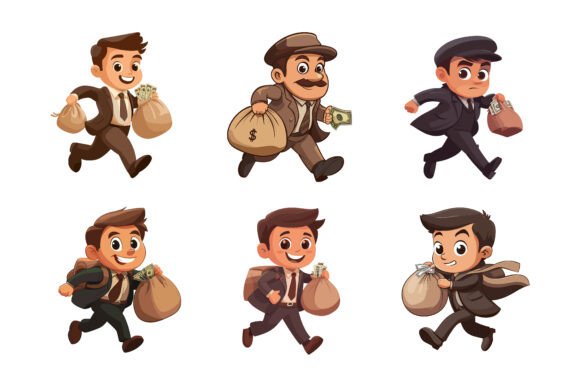
Robber Carrying Bag: Bringing Clarity to Complex Visual Messages
Picture a startup building an employee safety app. The interface needs a quick-hit visual for "report an incident" — something that communicates risk without resorting to cliché symbols. That’s exactly the gap filled by an illustration set featuring a robber carrying a bag. It offers immediate recognition, yet with enough nuance to stand apart in a crowded digital space.
This isn’t just a single sketch. The Robber Carrying Bag comes from a special AI EPS collection, crafted with layers you can tweak, colors you can shift, and details sharp enough for both mobile screens and billboard prints. It’s a vector-based asset where every shadow and strap has been thoughtfully placed. The set includes AI, EPS, and a high-res JPG preview, so you can inspect before editing. And because it’s built with consistency in mind, every icon in the pack shares the same line weight, perspective, and mood.
Where Theft-Themed Visuals Solve Real Communication Problems
Security professionals often need visuals that feel immediate but not cartoonish. In a workplace safety video, a robber carrying a bag can illustrate unauthorized access without using actual footage that might be distracting or sensitive. E-learning developers add this icon to quiz modules: “Which scenario indicates a security breach?” The image shifts from passive decoration to an active learning tool.
Banks and credit unions use variations in mobile app updates to warn about fraud. A subtle, semi-transparent robber icon alongside a phishing warning helps users make connections faster. Because the file is vector-based, it scales from a tiny notification badge to a full-screen intercom display without losing clarity. Insurance companies weave it into infographics that break down claim statistics, adding a human element to dry data. Even local police departments find value when designing community alert flyers — the illustration grabs attention at a glance.
Designers and Their Daily Dance with Deadlines
Freelancers juggling multiple clients rarely have time to sketch custom isometric thieves. Receiving an AI file where every element sits on a labeled layer means you can repurpose the robber for three different projects in an afternoon. Maybe the morning is a cybersecurity startup’s landing page, and the afternoon is a board game cover about heist adventures. Changing the expression, slimming the bag, or adding a glowing effect takes minutes, not hours.
The consistency of the Special AI EPS Collections also helps. When you need a series of icons — thief, police, vault, surveillance camera — they all share the same stroke width and perspective. Your infographic about retail shrinkage won’t look like a patchwork of mismatched styles. This neat organization extends to the file structure itself, where layers are named clearly rather than left as cryptic numbers.
Print Projects That Demand High-Resolution Integrity
Event organizers for safety expos love EPS files because output doesn’t get soft on large banners. A robber carrying a bag printed on a 10-foot pull-up stand stays crisp from the stitching on the duffel to the heel of the boot. Illustration designers paid meticulous attention to these details, so posters and flyers for community alert programs look professional without extra sharpening or tracing.
Magazines and local newspapers running stories on theft trends often use the JPG preview for quick layout placement, then swap in the vector master for press-ready PDFs. The cross-platform design means Windows users don’t need to email a Mac friend for conversion — just open and work. Screen printers appreciate how cleanly the paths separate, reducing pre-press headaches when preparing screens for apparel or signage.
Who Benefits Most from an Editable Thief Illustration?
It’s easy to think this serves only one niche, but the user base is surprisingly wide.
- Educators use it in law-themed slides; removing the mask prompts deeper talks about intent.
- App developers add it as a tutorial mission sprite in gamified security apps.
- Personal finance bloggers scale it for headers, signaling risk management topics.
- Law firms simplify the icon for property law presentations, deleting harsh details.
- Retail consultants integrate it into loss prevention training manuals, customizing bag sizes for different scenarios.
- Nonprofits run awareness campaigns where the robber evolves across a poster series, maintaining consistent character identity.
Practical Considerations Before You Download
Before integrating the Robber Carrying Bag into any project, think about your editing environment. The AI format opens in Adobe Illustrator and most vector programs like Affinity Designer, while EPS imports into a wide range of software. If you plan to tweak colors, test how your preferred app handles gradient meshes — some simplified editors flatten these into basic shapes, which can alter the three-dimensional feel.
Also, consider your audience’s cultural context. A masked figure may be interpreted differently across regions. Fortunately, the ability to modify details offers a quick fix: adjust skin tone, remove the mask, or swap the bag for a different prop. This control makes the asset far more versatile than a standard stock photo with a single model release.
Licensing is another factor. Most commercial illustration sets, including this one, come with royalty-free terms for multiple projects, but always check if extended print runs or merchandise production require an extra seat. The organized file structure hints at a professional source where such information is readily available. And with a JPG preview included, you can test compositions in mockups without prematurely committing to full edits.
Where the Strengths Shine and the Limits Lie
One undeniable strength is detail. The way light falls on the bag, the creases in clothing, the subtle weight of the pose — these touches help you avoid the lifeless appearance of free clipart. The layered organization means you can mute the background details for an app icon, or emphasize the full scene for a poster. The cross-platform compatibility and neat folder arrangement cut out friction for distributed teams.
However, if your brand language is ultra-minimalist — think thin lines, flat colors, no gradients — you may find the initial style a bit rendered. That isn’t a flaw; it’s a style choice. Because editing is easy, you can reduce opacity, strip colors, or knock out shadows to match a flat aesthetic, but that adds a bit of extra work compared to grabbing a pre-made flat icon. For most users targeting print, web, infographics, or app symbols as the collection suggests, the starting point saves far more time than it costs to adapt.
Infusing Narrative into Everyday Projects
Beyond functional icons, this illustration supports storytelling. A nonprofit campaign about urban safety might thread the robber figure through a series of posters: the bag in scene one, dropped at a police station in scene three. Because the file is editable, you maintain consistent character identity across media — something you can’t do when you stitch together five unrelated stock images.
Similarly, a mobile game developer can prototype a stealth scenario where the protagonist is the robber carrying the bag, morphing the symbol into a playable asset. The ability to recolor and restyle allows a grim security icon to become a lighthearted cartoon for a puzzle app. Such flexibility turns a flat purchase into a well of creative raw material, ready for symbols, apps, and infographics.
Staying Organized Across Operating Systems
The collection’s promise of neat organization and cross-platform compatibility is a real time-saver. Folders separate high-res JPGs from working vector files, and layers inside the AI document are named (“bag straps,” “figure shadow,” “mask”) rather than left as cryptic numbers. Designers who’ve fought through “Layer 17” in a five-year-old asset will appreciate this small courtesy. Mac and Windows users can both open and print without troubleshooting color profiles, because the EPS specification retains platform-neutral encoding.
For remote teams where different members use different systems, sharing the pack without technical friction keeps production moving. The JPG preview also serves as a reference for non-design stakeholders who may not have Illustrator installed. When deadlines tighten, the Robber Carrying Bag becomes a strategic tool — ready for your infographic, app, or flyer. Explore the collections and turn one vector into many creative outcomes.